FEATURE
No Margin for Error
American higher education is in its hardest stretch since World War II, and the margin for error has vanished. At Saint Leo University, the country's first deployment of an AI platform built only for universities is changing what a president can know, and when.
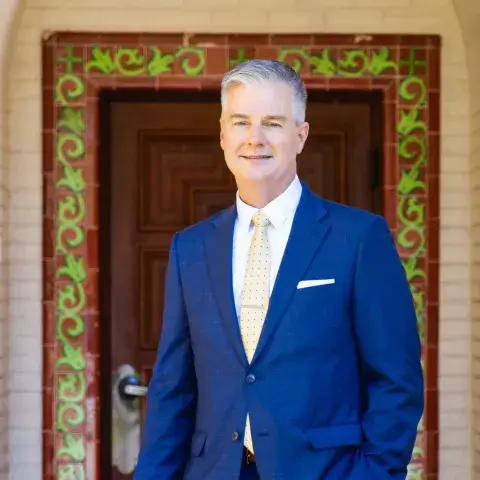
For twenty-five years, Dr. Jim Burkee has watched university presidents run their institutions on information that arrives too late to use. A student stops showing up in week one, and no one notices until midterms. Fall classes begin, and the president can't say how many students actually enrolled until the census count weeks later. A number goes to the board of trustees, and a week later someone quietly admits it was wrong. Burkee, a historian by training and now the twelfth president of Saint Leo University, has a plainer word for all of it: turbulence.
This is the hardest environment for American higher education since World War II. It feels like we are flying through turbulent weather that is blowing us around every single day.
Dr. Jim Burkee, President, Saint Leo University
The turbulence is not metaphorical. A long-anticipated demographic cliff is pulling millions of students out of the pipeline as fewer graduate high school and enroll in college. Federal policy is rolling back the number of international students by the hundreds of thousands. Families are questioning affordability, return on investment, and whether a degree is worth the price. Every one of those pressures lands on the same place: the tuition revenue that funds nearly everything a university does.
Burkee's summary of what that means for how a president has to operate is the line other presidents will recognize immediately. “The margin for error in this business has essentially disappeared,” he says. “There was a time when slow decisions were survivable. For many schools, that's not the case anymore.”
The data was always there. Nobody used it.
Ask Burkee where the problem starts, and he doesn't point at a shortage of information. He points at an ocean of it that no one has been able to touch. He has spent a quarter century inside institutions that measure everything and act on almost none of it in time. This fall, Saint Leo set out to change that.
The ordinary rhythm of campus life already generates the signals of whether a student is thriving or quietly disappearing. That information lives across the systems a university already runs. The difference is whether anyone can see it in time to help.
“We collect data all over the place,” Burkee says, “and then the data just sits there.” The information a university needs to support its students already exists inside the systems it runs every day. The gap has never been collecting it. The gap is turning it into something useful while it still matters.
The cost of that inaction is measured in students. At most American colleges, Burkee notes, the first point at which anyone intervenes with a struggling student can be midterms, because faculty don't take attendance and no one is watching the early signals. A student can stop attending for five or six weeks before a human being reacts, by which point that student is often already gone.
A different kind of visibility
The interview happened on the first day of fall classes. That morning, Burkee had come out of a meeting with his chief information officer about a capability Saint Leo is working to build, made possible by CogniEdu, an artificial intelligence platform built by Custom Technology Solutions (CTS) exclusively for higher education. Saint Leo is the first university in the country to deploy it.
The goal Burkee describes is a system that surfaces the students who need attention early, while there is still time to act, rather than at midterms when the semester is half gone. Today, pulling those signals together is still largely manual, and connecting the university's systems so the picture assembles itself is work in progress. But the direction is clear, and for a university that has never had that kind of early visibility, Burkee says, it will change what is possible.
What CogniEdu does, in Burkee's framing, is not complicated. It connects the systems a university already runs, the ones that were never designed to talk to each other, and turns the exhaust of daily campus life into something a leader can act on the same day. The firm behind it is led by Nadeem Mazhar.
Higher education doesn't need another dashboard. It needs its systems to finally talk to each other, and to answer the questions a president actually asks.
Nadeem Mazhar, Founder and CEO of Custom Technology Solutions
“How is it that I don't know?”
Before CogniEdu, Burkee describes a reporting process that will be painfully familiar to anyone who has run an institution. Data sits in separate systems, the registrar, financial aid, finance. Institutional research staff piece it together by hand, reconciling in spreadsheets, and the finished report can take days to reach the president. By the time it arrives, the moment to act on it has often passed.
For twenty-five years it was the same frustration: classes started and I didn't know until much later how we were doing. I didn't know who showed up, who didn't, or where we were trending.
Dr. Jim Burkee
He is careful to say this is not anyone's fault. “That's not a knock on anybody,” he says. “It's a limitation of the systems we've had, the tools we have, and our capacity to use them.” That limitation has real consequences three times a year, when Saint Leo's trustees meet. The fall board meeting lands a couple of weeks after census, presidents scramble to assemble the numbers, and then, Burkee says, “you find out a week later, oh, I've got to tweak this, I didn't quite get that right.”
A board that can check the president's math
This is where Burkee's story turns from operations to governance, and where his argument grows teeth that will get the attention of every trustee and CFO who reads it. Saint Leo went through hard financial times before he arrived, rooted, he says plainly, in bad information and major surprises reaching the board.
The governing rule of the relationship between a president and a board is simple, Burkee says: no surprises. The old machinery manufactured them. Recognizing an opportunity to apply relevant expertise, and following the university's normal governance process, Saint Leo engaged CogniEdu to give trustees clear, high-level indicators of the institution's financial and enrollment health, so oversight rests on current information rather than reports that are weeks old.
A trustee dashboard now gives a select group of trustees on key committees a current, high-level view of the university's health. Burkee describes the difference it makes in a board meeting: when his CFO presents, trustees are working from the same up-to-date picture rather than a report that is weeks old, so the conversation moves quickly from reconciling numbers to discussing what they mean. The effect is a better-informed board.
“It provides conversation and context, and it leads to a much more well-informed trustee,” Burkee says. Boards govern best when they share the same clear, current view as management, and in an environment with no margin for error, he calls that simply good governance.
Accountability people can feel
Burkee does not pretend the shift was frictionless. Asked whether his team was skeptical, he answers without hesitation: of course they were. But the fear, he says, was not that AI would take anyone's job. It was more human than that, the discomfort of knowing your work is now visible.
He tells a story at his own expense. Over a decade ago, teaching online for the first time at a large institution, he stayed after a meeting and the team lead gently told him the system had flagged him: a couple of student emails had taken him more than the twenty-four hours the program allowed, and he had returned papers in forty-eight hours instead of twenty-four.
I remember thinking, oh my gosh, they're watching what I'm doing. I'd never had that happen before. But it shaped how I thought from that point forward, and it made me a better teacher.
Dr. Jim Burkee
Whatever apprehension existed at Saint Leo at the start, he says, has long since passed. “We're in the world of AI now. We are embracing data. It means a brand new era of accountability and performance at this institution, and I'm excited about it.”
The part he is reluctant to say out loud
Presidents are trained to talk about mission, not cost, so Burkee flags what comes next as awkward before he says it. Then he says it anyway, because it is the argument a CFO cannot ignore.
CogniEdu, he says, is built to save the institution money. Universities spend heavily on institutional research, on the systems that support it, and on outside consultants who come in to run data. Among the capabilities on its roadmap is streamlining reporting for the Integrated Postsecondary Education Data System, the federal reporting every college must file with the U.S. Department of Education, work that has traditionally required significant staff time and often arrived late.
“What I've told my board,” he says, “is that from a financial perspective, what it lets me do with personnel in the data-gathering space more than compensates for the cost of the tool.” And that is before the harder-to-price gains: better data in real time, stronger board governance, and what he expects to be materially better student retention.
Minutes, not days
Saint Leo has already staked out a position as an AI-first institution, including a partnership announced with IBM to certify and train every student and faculty member in the use of AI. Burkee places CogniEdu inside that larger bet. Asked where he expects to be three years out, he describes an institution that sees itself clearly and moves at a different speed.
“An institution that reacts very quickly, in minutes, not days, between question and answer,” he says. He can already go into CogniEdu and ask how July's financials compare to the prior year and get an extrapolated trajectory for the rest of the year, in real time, rather than after the fact. Advisors catch retention risks early. Accountability is enforced with data rather than assertion. “I do think it's going to transform how we operate,” he says, “and it will give us a clear competitive advantage.”
Built for this, not adapted to it
Burkee has used enough enterprise software to know the difference between a tool built for higher education and a tool higher education has to bend itself around. “They didn't build a generic tool that higher ed has to work itself around,” he says of the CTS team. “There are a lot of those. This is built specifically for higher education.” He credits the firm with interviewing him, his provost, his CFO, and staff across the university to understand the questions that actually needed answering.
He is careful to place CogniEdu in context: one connected layer in Saint Leo's broader move to become an AI-first institution, built to make the university's people, data, and student success stronger. And capability, he notes, means little without control. What makes a platform trustworthy is the governance around it, strong security, disciplined access, accuracy, and data handling built to protect student records under the Family Educational Rights and Privacy Act. “For a university,” he says, “the data story isn't just what you can see. It's how carefully you protect it.”
Then he offers the line that tells you everything about how he rates it. He admits he was reluctant to help promote CogniEdu at all, for a reason that is its own kind of endorsement.
There was a part of me that was reluctant to help promote it, because I don't want anyone else to have it. But I've got a head start, and this will be good for the business.
Dr. Jim Burkee, President, Saint Leo University
For a sector flying through the roughest weather it has seen in eighty years, the head start is the whole point. The institutions that come through will be the ones that can see clearly and act fast while the storm is still overhead. Saint Leo has decided it intends to be one of them.
Briefing
See what one connected platform could show your institution.
Request a confidential briefing, or get the one-page summary of how Saint Leo did it.